
Sandstone Jali Price Per Sq Ft in India (2026): Rates by Stone, Thickness and Design
Last updated: October 2026 · Reading time: about 9 minutes · By Nancy Stone Articles, Sikandra (Dausa), Rajasthan
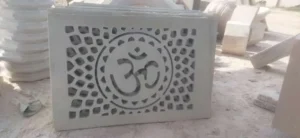
Short answer: Sandstone jali price per sq ft in India runs from about ₹150 for plain, thin red panels to ₹1,500 or more for deeply carved designer pieces. Most home projects (balcony, partition, boundary wall) land between ₹300 and ₹900 per sq ft. Our own decorative circular-pattern jali is quoted at ₹400 to ₹600 per sq ft, and the final rate depends on thickness, pattern depth, stone colour and order size.
Those numbers come from our own quotations and from supplier listings we reviewed in October 2026. They are a guide for planning a budget, not a fixed rate card. The rest of this article explains why the range is so wide, how to work out your own cost, and what to ask before you pay anyone.
Sandstone jali price per sq ft at a glance
| What you are buying | Typical thickness | Indicative rate (₹ per sq ft) |
|---|---|---|
| Plain or simple geometric 2D cut | 20 to 30 mm | ₹150 to ₹350 |
| Standard CNC pattern (circles, grids, stars) | 35 to 40 mm | ₹350 to ₹700 |
| Deep carved or designer pattern (Om, floral, mandir motifs) | 40 to 50 mm | ₹700 to ₹1,500 and above |
Read this table as a starting point. A 3D pattern in 40 mm pink stone and a flat pattern in 25 mm red stone are two very different jobs, even though both are called “jali” and both get quoted per square foot. If two suppliers give you very different numbers, the first thing to check is whether they are quoting the same thickness and the same pattern depth.
What is sandstone jali?
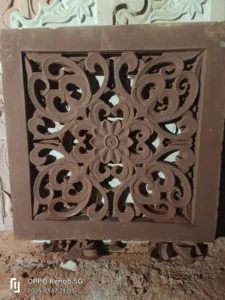
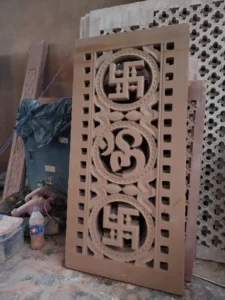
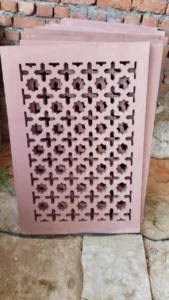
A jali is a stone screen with a repeating pattern of openings. It lets air and daylight through while keeping the space private. Sandstone is the most common material for it in India because it cuts cleanly on CNC machines, takes hand carving well, and has a warm natural colour that suits both traditional and modern buildings.
Most jali sold in India comes from Rajasthan. The stone is usually Dholpur red or white sandstone, or Bansi Paharpur pink sandstone from the quarries near Bansi Paharpur in Bharatpur district.
7 things that decide the price of a sandstone jali
1. Thickness
Thickness is the biggest single factor. A 40 mm panel needs roughly double the stone of a 20 mm panel, and thicker stone takes longer to cut. It is also stronger in handling and transport. Thin panels (10 to 20 mm) suit interior walls and cladding. For exterior use and balcony railings, most buyers go for 30 mm and above.
2. Pattern depth and complexity
A simple grid cuts in minutes. A dense floral pattern with fine bridges between openings takes far longer on the machine and needs more careful hand finishing. More machine time and more finishing means a higher rate per square foot.
3. Stone colour and grade
Red sandstone is generally the most economical. Pink and light white-pink stone are usually quoted higher for the same pattern, because blocks with an even colour are harder to find and more stone gets rejected. Stone with heavy banding or colour patches costs less but looks different on a large wall, so look at it before you commit.
4. Panel size and wastage
Large panels look cleaner with fewer joints, but they break more easily, and an offcut that cannot be reused is still paid for. Plan for about 5 to 7 per cent extra stone on any job with cut-to-fit edges.
5. Finish
A natural cut finish costs less than a honed or polished one. Hand-finished edges and sealing add labour.
6. Quantity
Bigger orders usually get a better rate because machine setup and pattern programming are spread across more panels. If you are only buying 20 to 30 sq ft, expect the rate to sit near the upper end of its band.
7. Packing, transport and fixing
Stone is heavy and jali is fragile. Wooden crating, loading, freight and unloading are real costs, and they grow with distance. Installation is a separate job. Many quotes leave both out, so ask.
How to calculate your jali cost (worked examples)
Use this formula:
Total cost = (area in sq ft + 5% wastage) × rate per sq ft + transport + fixing + GST
Example 1: Balcony railing panel
- Area: 10 ft wide × 3 ft high = 30 sq ft
- Add 5% wastage = 31.5 sq ft
- Rate quoted: ₹500 per sq ft
- Stone cost: 31.5 × 500 = ₹15,750 (before transport, fixing and GST)
Example 2: Room partition
- Area: 8 ft wide × 9 ft high = 72 sq ft
- Add 5% wastage = 75.6 sq ft
- Rate quoted: ₹600 per sq ft
- Stone cost: 75.6 × 600 = ₹45,360 (before transport, fixing and GST)
GST is charged on top unless your quote clearly says it is included. Check the rate and the HSN code on the invoice rather than assuming. Transport depends on weight and distance, so get it in writing as a separate line.
Sandstone jali vs other jali materials
| Material | Rough price signal | Strengths | Watch out for |
|---|---|---|---|
| Sandstone | ₹150 to ₹1,500+ per sq ft | Natural look, weather resistant, CNC and hand carving both work | Heavy, needs proper fixing |
| Marble | Listed from about ₹350 per sq ft and rising sharply with carving | Fine detail, polished look | Costlier, can stain, less suited to rough outdoor exposure |
MDF jali is the cheapest by far, but it belongs inside and has a short life near moisture. If the jali will face rain, sun and dust on a balcony or elevation, stone is the sensible choice.
Where sandstone jali works best
- Balconies and railings: privacy with airflow. Use 30 mm or thicker.
- Front elevation: a jali screen in front of a window or staircase cuts glare and gives the facade depth.
- Room partitions: separates pooja area, dining or study without closing the room off.
- Boundary and garden walls: a jali band at the top of a solid wall lets light in and looks lighter than a full wall.
- Mandir and temple work: carved jali panels are traditional in stone temples and work well as side screens.
- Ventilation openings: staircases, utility areas and terraces.
For anything structural, such as a freestanding wall or a heavy railing, get your architect or engineer to confirm the thickness and fixing detail. Do not choose thickness only on price.
8 mistakes buyers make when comparing jali quotes
- Comparing rates without comparing thickness. ₹300 for 20 mm and ₹450 for 40 mm may be the same value.
- Not asking which stone. “Sandstone” can mean red, pink, white, or a mix of lots with colour variation.
- Judging only from a photo. Photos hide colour banding and edge quality. Ask for a sample or visit the workshop.
- Forgetting wastage. Order exactly the wall area and you will be short.
- Ignoring packing. Ask how the panels will be crated and who is responsible for breakage in transit.
- Leaving fixing for later. Fixing is skilled work and the wrong method can crack panels.
- Accepting a verbal rate. Get the rate, thickness, quantity, GST and transport on paper.
- Believing “No. 1 in India” claims. There is no official ranking. Ask for completed projects and a way to verify them.
Questions to ask any supplier before you order
- Which stone (red, pink, white) and from which quarry?
- What is the exact thickness and tolerance?
- Is the pattern machine cut, hand carved, or both?
- Is the rate per sq ft for finished panels or for raw cut?
- What is the minimum order quantity?
- Is GST, packing and transport included?
- Who fixes it, and is fixing material included?
- Can I see a sample or a finished project?
How sandstone jali is made, and why it matters for price
At our workshop in Sikandra, Dausa, the stone is first cut into slabs of the required thickness. The pattern is then cut on a CNC machine, which keeps openings accurate and repeatable. Edges and details are finished by hand, and this is where much of the quality difference between suppliers shows up. Panels are checked, packed and dispatched.
Because the machine time and hand finishing differ so much between a simple grid and a deep carved pattern, the same square foot can cost very different amounts. That is the practical reason one fixed “per sq ft” number never fits every job.
Fixing and looking after sandstone jali
- Fixing: panels are normally fixed with stone-grade adhesive or cement mortar, often with stainless steel clamps or pins for exterior and load-bearing positions. The right method depends on the wall and the panel weight.
- Sealing: an exterior sealer helps against water and surface staining. Ask your supplier which product suits the stone you choose.
- Cleaning: a soft brush and mild soap with water is enough for dust. Avoid acid-based cleaners, since they can damage sandstone.
- Moss and stains: in damp spots, clean early before growth settles into the surface.
Our rates and how to get a quote
Nancy Stone Articles manufactures sandstone jali, wall panels, temples, chhatris, fountains and custom stone carving from Sikandra, Dausa (Rajasthan), and has completed 100+ projects across India. Our decorative circular pattern sandstone jali is quoted at ₹400 to ₹600 per sq ft, depending on size, thickness, stone selection and quantity.
To get an accurate quote, send us:
- Wall or opening size in feet
- Where it will be used (balcony, elevation, partition, boundary wall)
- Preferred stone colour
- A pattern reference photo, if you have one
- Delivery city
You can browse the stone jali collection, see our past projects, or contact us on WhatsApp or call +91 63756 49667. If you are also planning a temple, our guide to sandstone temple price in India covers that side of the cost.
Frequently asked questions
What is the sandstone jali price per sq ft in India? In 2026, sandstone jali typically costs ₹150 to ₹1,500 or more per sq ft. Plain thin red panels sit at the low end, and deep carved designer pieces sit at the top. Most home projects fall between ₹300 and ₹900 per sq ft.
Which is cheaper, red or pink sandstone jali? Red sandstone jali is usually cheaper than pink for the same pattern and thickness. Pink and white-pink stone with an even colour cost more because good blocks are harder to source.
How much will 100 sq ft of sandstone jali cost? At ₹400 to ₹600 per sq ft, 100 sq ft costs about ₹40,000 to ₹60,000 for the stone alone. Add around 5% for wastage, plus transport, fixing and GST.
What thickness of sandstone jali should I choose? Use 10 to 20 mm for interior cladding, 30 to 35 mm for balconies and partitions, and 40 mm or more for exterior and railing use. For structural positions, ask your engineer.
Is sandstone jali cheaper than marble jali? Generally yes, especially for carved work. Marble jali listings start higher and climb quickly with detail.
Is GST included in the jali rate? Not always. Many quotes are ex-GST. Ask for the rate, GST percentage and total on the written quote.
Can I get a custom pattern or size? Yes. Share a sketch, photo or dimensions and the supplier can quote a custom CNC pattern. Complex designs cost more.
Is sandstone jali suitable for outdoor use? Yes. Sandstone is a traditional outdoor material in Indian architecture. Use proper thickness, sound fixing, and seal it for rain exposure.
Conclusion
The cost of sandstone jali is decided by thickness, pattern depth, stone and quantity far more than by a single “per sq ft” headline. Work out your wall area, add wastage, compare quotes on the same thickness and stone, and always get transport, fixing and GST written down. If you want a quote based on your actual wall size, talk to our team.
Sources and basis for ranges: Nancy Stone Articles product pricing (decorative circular pattern jali, ₹400 to ₹600 per sq ft); supplier listings on IndiaMART reviewed in October 2026 for sandstone jali and stone jali. Prices are indicative and change with stone, design and market conditions.